




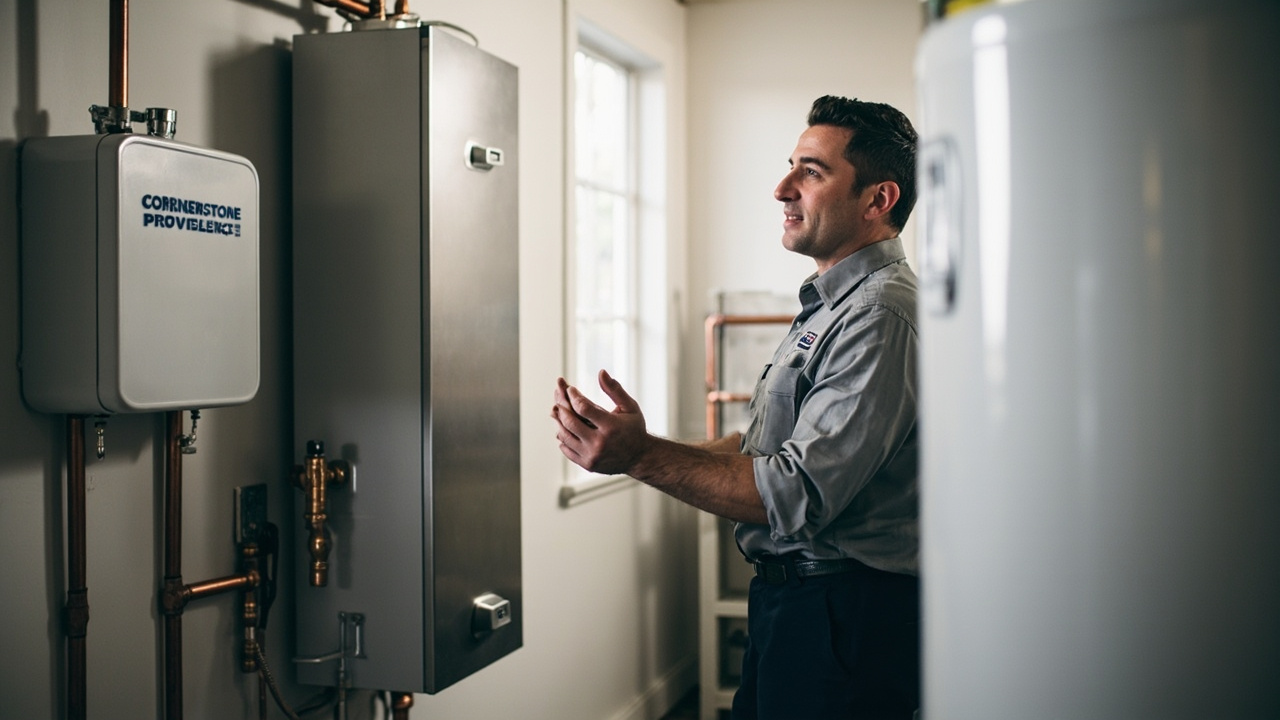


Providence's municipal water supply from the Scituate Reservoir system delivers moderately hard water with 150 to 180 parts per million dissolved minerals. This hardness level accelerates sediment buildup in conventional storage tanks, reducing efficiency and shortening tank life to 8 to 10 years without regular flushing. For tankless systems, the same mineral content clogs heat exchanger plates, requiring annual descaling to prevent flow restriction and element failure. The city's aging cast iron and galvanized distribution mains also introduce iron particulates that settle in tank bottoms and clog tankless inlet screens. Homes in Fox Point and the Jewelry District built before 1960 often have undersized supply lines that cannot deliver the 5 to 8 gallons per minute flow rates that instantaneous heaters need to maintain consistent output temperatures during peak demand.
Rhode Island's plumbing code requires specific venting standards for both atmospheric and power-vented water heaters that impact installation feasibility in Providence's densely built neighborhoods. Cornerstone Plumbing Providence maintains current knowledge of local permitting requirements and inspection protocols through Providence's Department of Inspection and Standards. We work within the constraints of Federal Hill's attached row homes and College Hill's historic preservation guidelines to design compliant installations that meet both safety codes and architectural review standards. Our familiarity with National Grid's service territory and typical gas pressure levels across Providence neighborhoods allows us to immediately identify whether your location can support a gas tankless conversion or whether you need pressure boosting equipment to meet manufacturer specifications.